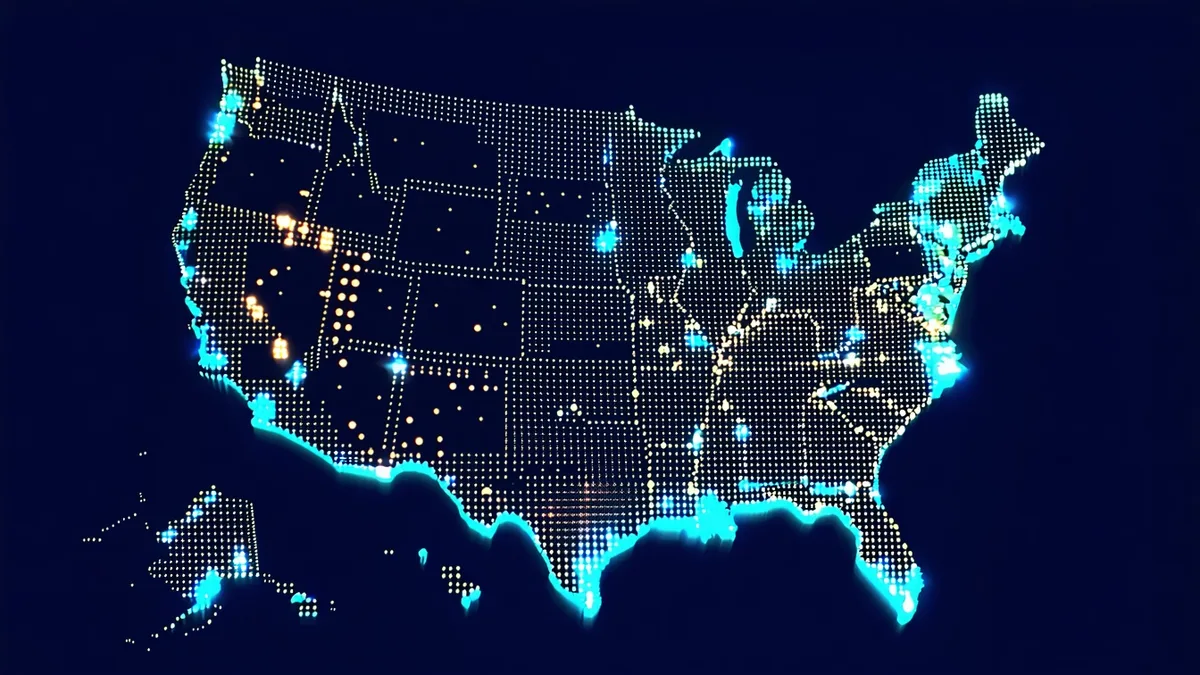
The geographic data available from podcast hosting platforms is almost universally treated as a curiosity rather than a strategic asset. A head of content glances at the country breakdown, notes that 73% of listeners are in the US, 12% are in Canada, and 6% are in the UK, then closes the tab. The DMA-level data — which shows city-level listener concentration within the US — often doesn't get looked at at all.
This is a genuine missed opportunity. Geographic concentration data in podcast analytics unlocks capabilities in advertiser targeting, live event planning, cross-promotion strategy, and even show development decisions that aren't accessible from any other data source available to networks. The question is knowing what to look for and how to translate the signal into decisions.
What the Data Actually Shows (And What It Doesn't)
Podcast geographic data is derived from IP geolocation of download requests. The IP address associated with a download is mapped to a geographic location — country, state, and DMA within the US — using geolocation databases maintained by providers like MaxMind or ip2location. This process has known accuracy characteristics:
- Country-level accuracy is typically 95%+
- State/region-level accuracy is in the 80–90% range for most major markets
- DMA-level accuracy is lower — approximately 70–80% for large DMAs, less accurate for smaller markets and rural areas
- Mobile cellular listeners (a large share of podcast listeners) may be geolocated to the carrier's regional gateway rather than their physical location, which can produce systematic misattribution in some markets
The data is useful at the aggregate level for understanding audience geographic distribution. It's not reliable enough for individual-listener-level targeting, and you shouldn't use it as though it is. For "we have roughly 18,000 listeners in the Chicago DMA" purposes, it's actionable. For "we can target a specific Chicago neighborhood" purposes, it's not.
Regional Advertiser Pitch Strategy
The clearest monetization application of geographic concentration data is the regional advertiser pitch. National advertisers (direct-to-consumer brands, subscription services, financial products) care primarily about audience scale and demographic profile. Regional advertisers — local restaurant chains, regional banks, real estate services, healthcare networks with specific market coverage areas — care primarily about whether you can reach their specific geographic market.
A podcast network with 45,000 average weekly downloads across its portfolio, of which 8,000 are in the Dallas–Fort Worth DMA, has a genuinely compelling product for advertisers targeting the DFW market. Those 8,000 DFW listeners are a more targeted audience than what a regional radio buy or a digital display campaign can typically deliver at a comparable CPM — podcast listeners are better identified and more demographically specific than the average radio audience.
The pitch to a regional advertiser requires pulling a geographic breakdown for each show in the portfolio that has meaningful DFW concentration, then packaging that as a network buy with DFW-specific audience data. Dynamic ad insertion (DAI) platforms that support geographic targeting can serve the regional sponsor's ads only to listeners in the DFW DMA, which means the regional advertiser is paying for targeted geographic impressions rather than national reach they don't need. DAI geographic targeting with DMA-level data is a product most networks have the infrastructure to offer already — they just haven't operationalized the geographic analytics to present it as a value proposition.
For a growing network with concentrated geographic presence, 2–4 regional sponsorship arrangements across the network's highest-concentration DMAs can meaningfully improve sell-through rate and total CPM on inventory that would otherwise sell at remnant programmatic rates.
Live Event Planning and Geographic Signal
Networks that run live events — live recordings, listener meetups, festival appearances — frequently make venue decisions based on where the host lives or where a conference happens to be, rather than where the audience is concentrated. Geographic data provides a more principled basis for these decisions.
A 12-show network with listener concentration data showing that 30% of total downloads come from the New York, Los Angeles, and Austin MSAs has a clear argument for routing live events through those markets. The expected attendance pool from existing subscribers is much larger in those markets than it would be in a market where 1% of total downloads originate. Ticket conversion rates from existing listeners are typically 2–5% for well-positioned live events — for a show with 5,000 listeners in a DMA, that's a realistic base of 100–250 ticket buyers before any external promotion.
Geographic data also informs the decision about whether a live event in a given market makes sense at all. A show that gets 300 downloads per month from the Boston DMA does not have the audience density for a standalone Boston live event. That same show might be a strong fit as a co-headliner at a multi-show event in Boston if another network show has 3,000 Boston listeners — the combined audience density makes a single event viable for both shows together.
International Breakdown and the Opportunity Most Networks Miss
Most podcast networks with significant US audiences treat international listeners as a bonus that doesn't require special attention. This is understandable for networks where 90%+ of downloads are domestic — international audience doesn't change the sponsorship model materially if it's a small fraction.
For networks where 20–35% of downloads come from outside the US — a pattern common in shows covering topics with global professional relevance: technology, business, science, policy — the international breakdown deserves more attention than it typically gets. The UK, Canada, Australia, and Germany are the largest non-US podcast markets (collectively accounting for 15–20% of global podcast consumption in most verticals). Networks with concentrated UK or Australian listener bases have a product relevant to advertisers targeting those markets, and may be undercharging for sponsorships because they're pricing based on total download count without accounting for the geographic composition.
International geographic data also has implications for show development. A network running a show about US-specific topics that's nonetheless finding a significant Australian audience might be missing an opportunity to develop content that speaks more directly to that audience — either as a spinoff show or as a segment within an existing show. The international signal is audience demand for something your network can serve; most networks don't look at it as a programming input.
Using Geographic Data in Cross-Promotion Planning
Geographic distribution of listeners is a useful input when planning cross-promotion between shows on the same network, though it's often underused in this context.
If Show A has 60% of its audience in West Coast US markets and Show B has 50% of its audience in East Coast and Midwest markets, a cross-promotion between these two shows will naturally reach an audience where a significant portion haven't been exposed to the other show. Cross-promotions between shows with highly overlapping geographic distributions, by contrast, are reaching audiences where most listeners have probably already been aware of both shows. Geographic overlap is one proxy for audience overlap — not a perfect one, but a useful filter.
For a network running 8+ shows, geo-mapping the audience of each show once per quarter and identifying which show-pairs have the most geographic divergence is a 2-hour analysis task that can meaningfully improve cross-promotion targeting. You're looking for pairs where one show has strong concentration in markets where the other show is weak — those are the highest-value cross-promotion pairs because they're genuinely expanding each show's geographic reach rather than just recycling the same audience back to itself.
What the Data Can't Tell You
Geographic concentration tells you where your listeners are. It doesn't tell you why they're there, whether the geographic concentration reflects genuine regional relevance of the content or random clustering effects, or whether listeners in high-concentration markets are more or less valuable than listeners in low-concentration markets as a subscriber audience.
We're not saying geographic data is a decision-making shortcut. We're saying it's a regularly available signal that most networks treat as decorative rather than operational, and that treating it operationally — by building it into advertiser pitch decks, event planning, and cross-promotion strategy — produces concrete monetization and growth benefits that don't require any additional data collection, just better use of data you already have.